What Is Yoga Therapy: The Science, The Philosophy, And Why Nurses Need It
What Is Yoga Therapy: The Science, The Philosophy, And Why Nurses Need It
I'm going to say something that might surprise you coming from a yoga therapist.
If you've looked at yoga and thought "that is absolutely not for me." You're probably right. About what you've seen. Most of what we see in social media and in studios is NOT yoga therapy. It's gymnastics with a Sanskrit soundtrack. It's bodies doing things that have no business being called accessible. It's an industry that took a practice thousands of years in the making and flattened it into a fitness trend.
And if you're a nurse who is already exhausted, already running on nothing, already giving everything you have to everyone around you, the last thing your nervous system needs is another place where you're expected to show up and perform.
So let's talk about what yoga therapy actually is. Most people have little knowledge of yoga therapy. That gap in understanding is a barrier that is costing people access to something genuinely powerful.
A Practice Thousands Of Years In The Making
Before we talk about what yoga therapy is not, I want to start where it actually begins.
The history matters. The philosophy matters. Unfortunately, it gets left out of the conversation far too often.
Yoga is not a modern wellness invention. It is a sophisticated system of knowledge rooted in Vedic philosophy - a body of wisdom that has been refined and transmitted across thousands of years, long before the first gym opened a yoga class or the first influencer posted a handstand on Instagram.
The ancient texts, The Yoga Sutras of Patanjali, the Bhagavad Gita, the Upanishads, were never primarily about physical postures. They were maps of the human experience. Frameworks for understanding how we suffer, how we create meaning, how we relate to ourselves and each other, and how we move toward something that looks a lot like what modern neuroscience now calls nervous system regulation.
The rishis (the ancient seers and scholars who developed these frameworks) were the scientists of their era. They were doing rigorous, systematic inquiry into the nature of the mind, the body, and consciousness itself. Without fMRI machines. Without polyvagal theory. Without peer reviewed journals.
What they documented thousands of years ago, modern neuroscience keeps finding evidence to support their findings.
That is not a coincidence. That is the depth of what we are working with.
Where Ancient Wisdom Meets Modern Neuroscience
This is the heart of what I do. This is what I mean when I say Neuroscience meets mindfulness.
Yoga therapy draws on both. Not as competing frameworks. They are complementary lenses that highlight the same area from different directions.
The Pancha Kosha model is a Vedic framework that maps five layers of human experience from the physical body through breath, mind, intellect, and bliss. These layers are maps with striking precision onto what we now understand about the layered architecture of the nervous system and embodied cognition.
The ancient understanding of prana, the life force energy that moves through the body via specific pathways finds its modern parallel in the vagus nerve, the autonomic nervous system, and the bidirectional communication between body and brain that researchers like Stephen Porges and Bessel van der Kolk have spent careers documenting.
The Yamas and Niyamas are ethical and behavioral principles at the foundation of yogic philosophy. These pearls of wisdom are essentially a framework for how to live in a regulated, connected, values-aligned nervous system state. They are not moral rules handed down from above. They are practical wisdom about what it actually takes to be a human being who is not constantly at war with themselves or the world around them.
None of this is metaphor. None of this is spirituality disconnected from physiology.
It is an integrated understanding of what it means to exist in a body. Your body. The one that yoga therapists are trained to work with across all of those layers simultaneously.
So What Actually Is Yoga Therapy
Yoga therapy is a clinical, body based approach to working with the whole person. The physical, physiological, psychological, and energetic person using the tools and frameworks of this ancient tradition, informed by current evidence in neuroscience and somatic psychology.
As a C-IAYT, a certified yoga therapist through the International Association of Yoga Therapists, I work at the intersection of that clinical framework and the body's own intelligence. My training is rigorous. My approach is trauma informed. My extensive time and experiences in healthcare inform every single session.
This is not me guiding you through a flow class. This is me working with your specific nervous system, your specific history, and your specific body across all of the layers that make you who you are. This is done along with you to help create the conditions for something to genuinely shift.
The Question Yoga Therapy Actually Asks
Most of healthcare and quite frankly, most of life, is organized around the question "what do you need to do?"
Yoga therapy asks a different one. What is your body already doing? What is your nervous system organizing around? And what does it need in order to feel safe enough to do something different?
That distinction is everything.
The patterns that keep burnt out nurses stuck are not lack of will power or inherently flawed personalities. It is not laziness, weakness or lack of discipline. What keeps nurses stuck are physiological adaptations layered on top of deeply conditioned psychological patterns. Some of these patterns are ancient in their own right, woven into the fabric of how you learned to survive long before you ever set foot in a hospital.
Your nervous system learned to adapt to high threat environments and it got really good at it. The constant vigilance. The ability to compartmentalize and suppress emotions. We learned to override hunger, ignore fatigue, and flat out refuse pain signals to keep going because the alternative wasn't an option.
Your body has been doing exactly what it needed to do to get you through.
The problem is that survival mode was never designed to be a permanent place to live.

What Happens When Survival Becomes The Baseline
When your nervous system has been running on override for long enough, it stops registering safety even when safety is present. The threat response that kept you sharp on a night shift doesn't clock out when you do. It comes home with you. It sits at the dinner table. It stares at the ceiling at 3am even when there is nothing left to solve.
You might recognize this as feeling wired but completely depleted. Unable to rest even when you finally have time to. Disconnected from your body. Emotionally flat. Going through the motions of self care without feeling any of it land.
This is not a personal failure. This is a nervous system that has never been given the conditions it needs to reset. And it is a pattern that the ancient yogic practitioners observed and documented long before we had language like dorsal vagal shutdown or sympathetic activation to describe it.
The wisdom has always been there. We are simply now able to explain the mechanism.
What The Work Actually Looks Like
I want to be honest with you about this because people often expect something more dramatic.
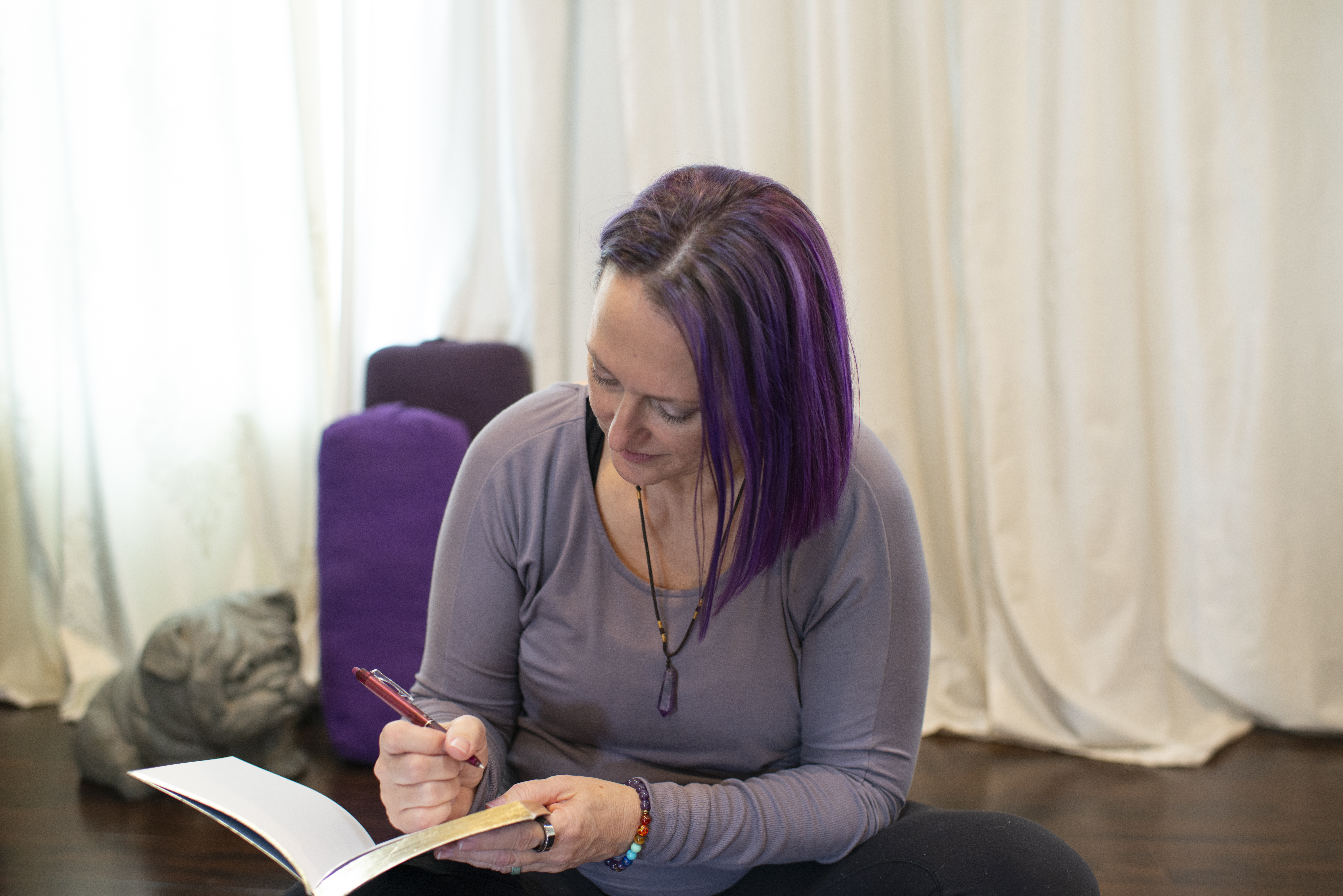
Sometimes yoga therapy looks like sitting in a chair and noticing the quality of your breath. Sometimes it looks like slow, intentional movement that meets your body exactly where it is not where you think it should be. Sometimes it looks like working with breath practices that have been used for thousands of years to regulate the nervous system, that we now understand act directly on the vagus nerve and the parasympathetic response. Sometimes it looks like sitting with a philosophical framework (a concept from the Yoga Sutras or the Yamas and Niyamas or another book that we may be referencing) and discovering that it describes your experience more accurately than anything you've encountered in a nursing journal.
Sometimes it looks like pausing long enough to actually register what is happening inside you instead of overriding it for the thousandth time.
No performance. No getting it right. No pushing past your limits in the name of growth.
What we are doing is building something your nervous system may not have experienced in a very long time. It's learning to be able to sit with the discomfort while your body develops the felt sense that it is allowed to settle. That the threat is not constant. That you do not have to hold everything.
What This Is Not About
Let me be very clear on this point. This is not about fixing you.
I want to say that as plainly as I possibly can because it is the thing most people need to hear before they can actually receive this work.
You are not broken. Your body has been adapting to an overwhelming environment for years. What we are doing together is not repair. It is not rehabilitation of something that went wrong.
The ancient teachings were clear on this. The Yoga Sutras don't begin with a problem to be solved. They begin with an observation that suffering exists, that it has identifiable causes, and that those causes can be understood and worked with. Not because something is wrong with the person suffering. But because suffering is a human experience that responds to the right conditions.
Modern neuroscience says the same thing in different language.
You are not broken. You are responding. Your responses make complete sense given everything your system has been through.
Why This Matters For Nurses Specifically
I work primarily with nurses because I am one. I know this world from the inside. I know what a twelve hour shift in a critical care unit does to a human body. I know the culture of override and self abandonment that gets normalized so gradually you stop noticing it's happening.
I also know what it feels like to get to the tail end of a bedside career and realize that nobody, not one person in twenty years of healthcare, ever taught me how to process what I was absorbing. How to complete the stress cycle. How to come home from a shift and actually arrive.
Yoga therapy with its thousands of years of wisdom about the human experience and its rigorous modern evidence base is what I wish had been available to me earlier. It is what I now offer to nurses who are ready to stop surviving and start actually living in their own bodies again.
This Is What Self Care As Health Care Actually Means
If traditional self care hasn't worked for you, it is not because you are doing it wrong. It is because a depleted nervous system needs a different approach. One that is gentle, more specific, built around your actual capacity, and rooted in something deep enough to meet the weight of what you've been carrying.
Thousands of years of Vedic wisdom and decades of neuroscience research agree on this. The body is intelligent. The nervous system is adaptive. Given the needed conditions, the human system moves toward regulation, connection, and wholeness.
That is not optimism. That is biology meeting philosophy.
Your body has been sending you messages for a long time. This work helps you finally learn to hear them. 💜
If you're a nurse ready to explore this work, the Yoga for Non Bendy People membership was built specifically for you.


